If you walk down the tree-lined streets of Culver City near Carlson Park or the Arts District, you will notice two things: gorgeous, mature trees and incredibly cracked, uneven concrete sidewalks. Those beautiful jacarandas and ficus trees are neighborhood treasures, but their roots are absolute monsters when it comes to your driveway, walkway, or patio.
Pouring concrete in Culver City is not as simple as mixing some powder with water and dumping it into a frame. Between our highly expansive clay soil, aggressive local tree roots, and notoriously strict local building inspectors, a DIY job or a cheap, unlicensed hire will almost certainly crumble, crack, or get shut down by the city within a year.
Here is what you actually need to know to get a beautiful, long-lasting concrete pour without getting ripped off or facing city fines.
The Culver City Soil and Tree Problem
Underneath our lush lawns is a heavy, clay-rich soil. When it rains (on those rare, heavy Southern California winter days), clay absorbs water and swells up like a sponge. When the dry summer heat hits, it shrinks and cracks. This constant movement is called soil expansion, and it will snap weak concrete like a dry cracker.
To make matters worse, those tree roots we all love are constantly hunting for water. They will find the moisture trapped underneath your concrete slab and push upward with immense force.
If your contractor does not plan for this, your brand-new driveway is doomed. A quality local contractor knows they must:
- Excavate deep enough: You cannot just scrape the grass off and pour. A solid job requires digging down at least 8 to 10 inches.
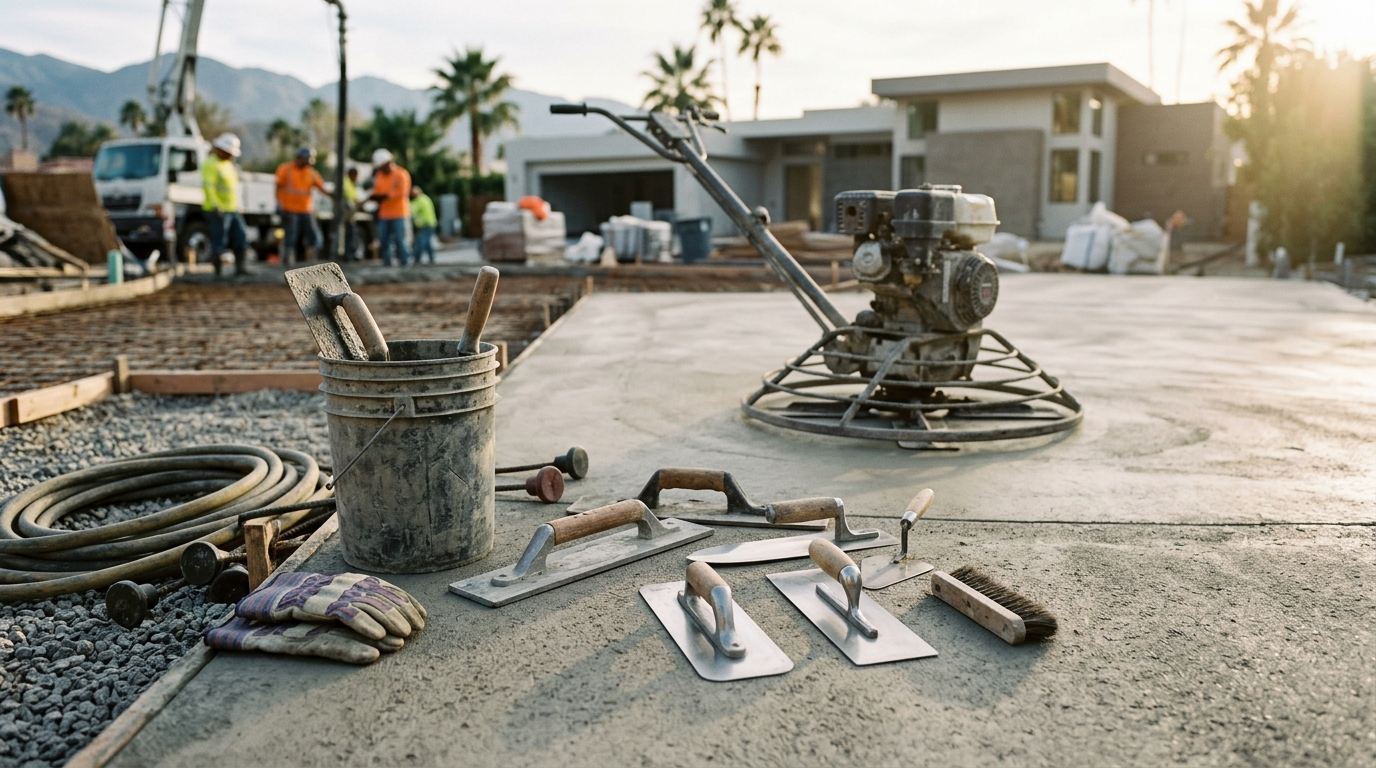
- Lay a proper subbase: You need at least 4 inches of compacted Class 2 road base (crushed gravel and dirt). Clay soil cannot support concrete directly. The gravel acts as a cushion and allows drainage.
- Install heavy-duty reinforcement: Do not let a contractor convince you that "fiber-mesh" mixed into the concrete is enough on its own. For driveways and high-traffic areas in LA, you want steel rebar (grade 40 or 60) spaced in a tight grid. It holds the slab together when the ground shifts.
Real-World Concrete Costs in Los Angeles County
Let's talk about the elephant in the yard: price. Concrete is heavy, labor-intensive, and material costs have risen steadily over the last few years. If you get a bid that sounds too good to be true, it is because the contractor is planning to cut corners on the thickness of the slab, the gravel base, or the steel reinforcement.
Here is what you should realistically expect to pay in Culver City and the surrounding Westside areas:
- Basic Gray Concrete (Driveways, Patios, Walkways): $9 to $16 per square foot. A standard two-car driveway (roughly 400 square feet) should cost between $3,600 and $6,400.
- Stamped or Decorative Concrete: $18 to $32+ per square foot. This includes coloring, custom textures, or patterns that mimic stone or brick.
- Demolition and Hauling of Old Concrete: $3 to $7 per square foot. LA County dump fees for heavy inert materials are incredibly high, and hauling old slabs away takes heavy machinery and labor. Make sure this cost is explicitly itemized in your quote.
If a contractor quotes you $5 a square foot for a brand-new driveway, they are likely going to pour a thin, 2-inch slab with no gravel and no steel. It will look great for three months, and then it will crack the first time you park an SUV on it.
Shady Tactics and Red Flags to Avoid
Because concrete work requires a lot of cash flow up front for materials and pump trucks, the industry attracts its share of sketchy operators. Protect your wallet by watching out for these common warning signs.
The "Leftover Concrete" Scam
This is a classic that still happens around Culver City and Palms. A guy in an unmarked truck knocks on your door and says, "Hey, we just finished a commercial pour down the street near Sony Studios and have half a truck of wet concrete left over. I can do your driveway right now for a fraction of the cost."
Do not do it. First, concrete that has been sitting in a rotating drum too long begins to set and lose its strength. Second, they will dump it directly onto your lawn or unprepared soil with zero prep work. It will crack and sink within weeks, and you will have to pay thousands of dollars just to have it jackhammered out.
The Lack of a C-8 License
In California, anyone doing concrete work over $500 must hold a valid C-8 Concrete Contractor license or a B General Building license from the Contractors State License Board (CSLB).
Ask for their license number and verify it on the CSLB website. Make sure they also carry active workers' comp insurance. If a worker gets hurt on your property and the contractor is unlicensed and uninsured, you can be held personally liable for their medical bills.
The Handshake Agreement on Permits
Culver City has its own independent municipal government and building department, and they do not mess around. If you are doing work on a driveway apron (the part that crosses the sidewalk and meets the street), you absolutely must have a permit from the Culver City Public Works Department.
If a contractor tells you, "We don't need a permit, we'll just do it fast over the weekend," do not hire them. City inspectors drive our neighborhoods daily. If they catch an unpermitted pour, they will post a stop-work order, fine you, and potentially force you to rip out the wet concrete at your own expense.
How to Keep Your Project on Track
Before you sign any contract or hand over a deposit, make sure the agreement is incredibly detailed. A professional bid should specify:
- PSI Rating of the Concrete: For driveways, you want a minimum strength of 3,000 to 4,000 PSI (pounds per square inch).
- Slab Thickness: Standard residential driveways must be at least 4 inches thick. If you park heavy trucks or RVs, aim for 5 to 6 inches.
- Subbase Details: It must state the depth of the gravel base and how it will be compacted.
- Reinforcement details: Specify the size and spacing of the steel rebar.
- Control Joints: Concrete will shrink as it cures. Professional contractors cut or tool "control joints" (the deep lines you see in sidewalks) into the slab. These act as planned weak points so that when the concrete inevitably cracks, it cracks cleanly along the line where you can't see it.
Browse local business listings and confirm qualifications, availability, licensing, and pricing directly with the business. LA Services does not independently verify or endorse the businesses listed in the directory.