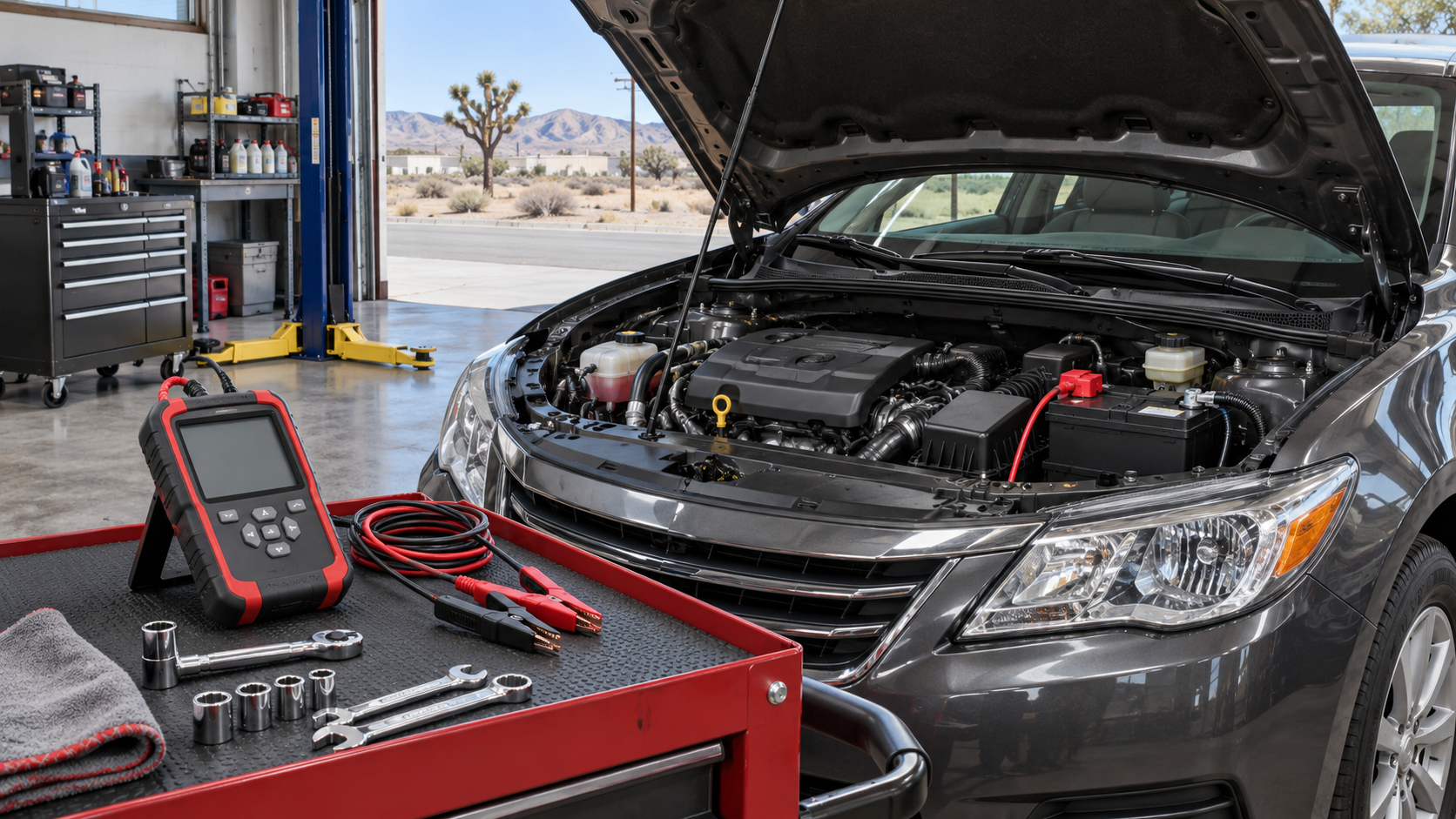
Start with what happens when you turn the key
When your engine turns over slowly, a new battery can seem like the obvious fix. Sometimes it is. But loose connections, damaged cables, a charging problem, or a worn starter can produce similar symptoms. Replacing a part before testing the system may leave you with the same starting trouble.
For drivers in Palmdale, the useful question is: what test will show why the engine is cranking slowly? A clear description of the symptom, followed by a few targeted checks at an auto repair shop, helps separate the likely causes.
This guide focuses on an engine that struggles to turn over. If the engine spins at its normal speed but never starts, tell the shop that instead. That symptom calls for a different diagnostic path.
Describe the sound and timing
You do not need to diagnose the car yourself. You do need to describe what it does as accurately as possible.
Before contacting a shop, note which description fits:
- Slow, labored cranking: The engine turns, but noticeably more slowly than usual.
- Rapid clicking: You hear repeated clicks without the engine turning normally.
- One click or a heavy clunk: There is a single sound, followed by little or no engine movement.
- Silence: The vehicle does not attempt to crank.
- Normal cranking without starting: The engine turns at its usual speed but does not run.
These observations are clues, not proof of a failed component. Clicking, for example, does not automatically establish that the starter needs replacement.
Timing also matters. Does the problem happen after the car sits overnight, after several days parked, or when restarting a warm engine after a short stop? Does it occur every time or only occasionally?
A short recording from inside the cabin can help demonstrate an intermittent symptom. Make it while safely parked, and avoid repeated starting attempts just to capture a better recording.
Know when to stop trying
Follow the starting instructions and limits in your owner's manual. Repeated, prolonged cranking can discharge the battery and place additional strain on starting components.
Stop attempting to start the vehicle if you notice smoke, a burning smell, grinding, or a battery that appears swollen, cracked, or leaking. Arrange professional assistance rather than continuing to test it.
If the car is parked near traffic, prioritize getting assistance from a safe location. Troubleshooting beside a busy road is not worth the exposure.
A jump-start may help in some situations, but the procedure and connection points vary by vehicle. Consult the owner's manual or use roadside assistance. Hybrids and electric vehicles can have specific procedures for their low-voltage systems; do not touch orange high-voltage cables or components.
Gather a few useful details before the appointment
Give the shop a brief history rather than a list of parts you think need replacing. Useful details include:
- The battery's approximate age, if known.
- Whether the problem began suddenly or gradually.
- Any recent battery replacement, electrical work, or accessory installation.
- Whether the vehicle has needed a jump-start, and what happened afterward.
- Whether it often sits unused or mainly makes short trips.
- Any battery or charging warning messages you have seen.
Mention dash cameras, aftermarket alarms, audio equipment, or other accessories that remain connected while parked. They may be relevant if the battery loses charge while the vehicle is off.
You can also look for obvious corrosion or a loose-looking battery mounting bracket without touching or disconnecting anything. Leave terminal cleaning, cable tightening, and battery removal to the shop if you are unfamiliar with the procedure. Some vehicles require specific steps after power is disconnected.
Ask for testing that separates the possible causes
A useful diagnosis considers the battery, connections, starter, and charging system together. The exact sequence depends on the vehicle and the symptom.
Battery condition and state of charge
A discharged battery and a battery that can no longer perform properly are different findings. Ask whether the battery was sufficiently charged for the test and whether charging and retesting are needed before making a replacement decision.
A voltage reading alone does not fully describe starting ability. The shop may use a conductance test, load test, or another manufacturer-appropriate method. Ask for the result and a plain-language explanation of what it means.
Cable and connection performance
A battery can be serviceable while resistance in a terminal, cable, or ground connection limits power reaching the starter.
Ask whether the technician checked the connections and whether a voltage-drop test during cranking is appropriate. This can help identify a connection problem that may not be obvious from a quick visual inspection.
Starter operation
If the battery and its connections check out, the technician may evaluate starter current draw, voltage reaching the starter, and related controls.
An occasional failure after a warm restart may require testing under those conditions. Tell the shop when the symptom occurs so it can plan the inspection. A successful start in the service bay does not explain why the vehicle struggled earlier.
Charging performance
The charging system replenishes the battery while the engine runs. A charging fault can leave a usable battery undercharged.
Modern charging systems can vary their output, so ask the shop to interpret measurements using the vehicle's specifications. Avoid treating one generic voltage number as a universal pass-or-fail rule.
If it starts after a jump, there is still a question to answer
A successful jump-start shows that additional electrical support helped the vehicle start. It does not, by itself, prove that the battery is the only problem.
If the battery repeatedly loses charge while parked, further diagnosis may involve checking for excessive electrical draw after the vehicle's systems have gone to sleep. That can take time, especially when the condition is intermittent.
Tell the shop how long the vehicle usually sits before trouble appears. Ask whether it needs to keep the car overnight or begin testing after a particular rest period. Agree on the diagnostic scope and contact point before leaving it.
Do not assume that an arbitrary drive after a jump will fully recharge the battery. Ask whether controlled charging and a retest are needed.
Review the recommendation before approving parts
Ask the shop to connect each proposed repair to a finding. A clear explanation might identify a failed battery test, excessive resistance at a connection, or abnormal starter operation.
Before authorizing work, clarify:
- What testing the diagnostic charge includes.
- Which findings support the proposed repair.
- Whether additional testing could change the recommendation.
- The parts, labor, and other charges included in the estimate.
- The applicable parts and labor warranty terms.
- How the shop will seek authorization if the scope changes.
If the battery needs replacement, ask whether the vehicle requires a particular battery type or a registration or reset procedure. Vehicles with stop-start systems may have requirements that differ from a basic replacement.
For current California guidance on estimates, authorization, invoices, and repair concerns, consult the California Bureau of Automotive Repair's consumer resource.
Book the visit around the symptom
When browsing local auto repair listings, look for shops that describe electrical diagnosis or starting and charging system service. Then ask whether they can test your vehicle's battery, cable connections, starter, and charging system.
A useful booking description is: “The engine cranks slowly after sitting overnight, but usually restarts normally later. I'd like the starting system tested before approving replacement parts.”
After the repair, keep the invoice and test results. If the symptom returns, record when it happened and contact the shop with those details. A documented starting problem is easier to follow up than a general report that the car still seems unreliable.