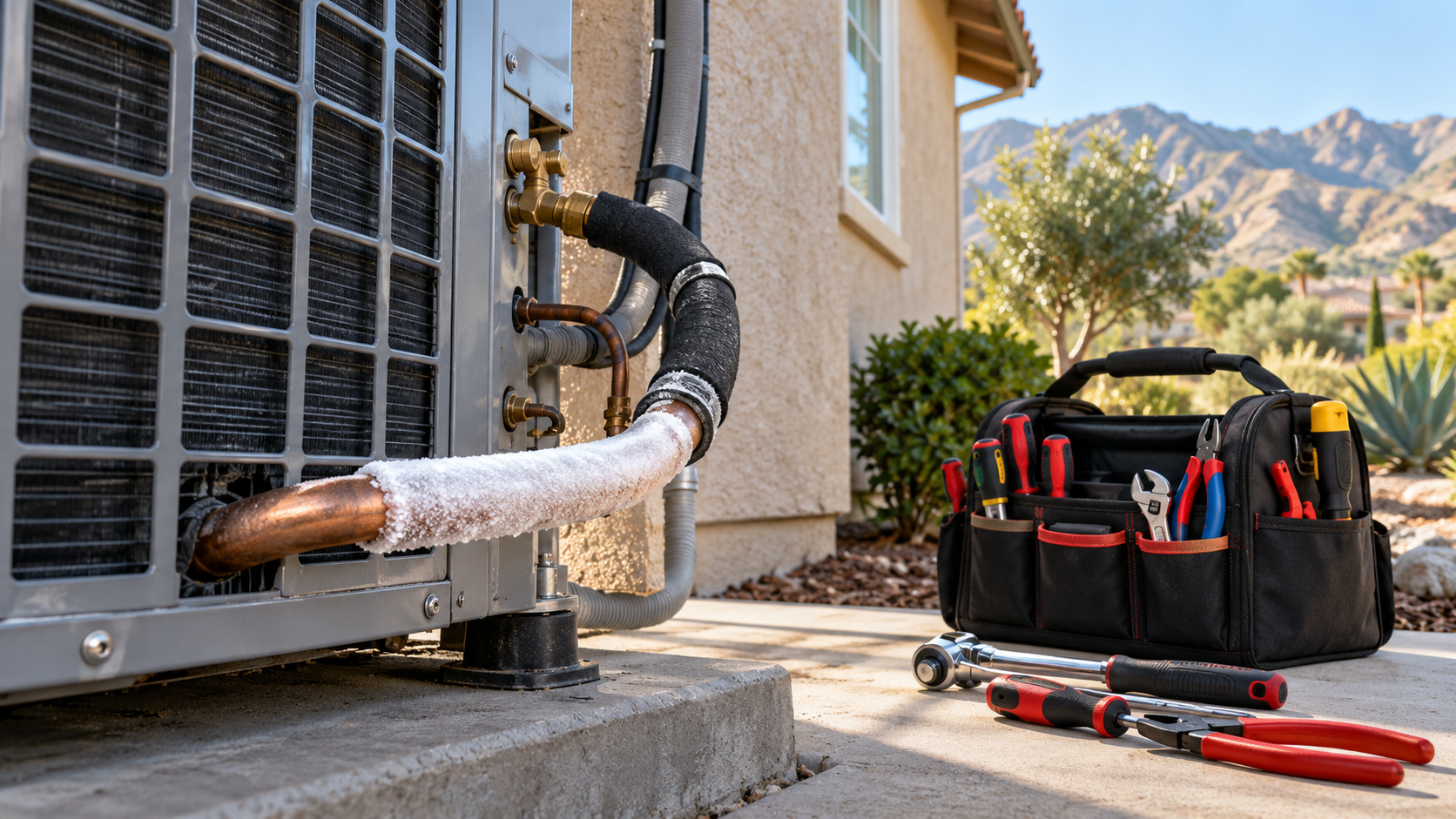
Found ice on your AC? Turn cooling off first
Ice on an air conditioner can seem surprising during a warm Azusa afternoon. You may notice frost on an exposed refrigerant line, water near the indoor unit, or weak airflow while the system keeps running. The house feels warmer even though the equipment sounds busy.
The useful first step is to stop the cooling cycle, not lower the thermostat further. Set the thermostat’s cooling mode to off. Continuing to cool while the system is frozen can make the problem worse.
Ice is a symptom, not a diagnosis. Restricted airflow and refrigerant problems are possible causes, and they require different repairs. Your immediate task is to let the equipment thaw safely, check the few things accessible to a homeowner, and decide whether a technician should inspect it before another cooling cycle.
Decide whether a thermostat shutdown is enough
If you see only frost and reduced airflow, start by turning cooling off at the thermostat. Keep people and pets away from the equipment while you look for water from a safe position.
Stop troubleshooting if you notice smoke, a burning smell, sparking, a repeatedly tripping breaker, or water reaching electrical components. Do not touch wet equipment, open an electrical compartment, or keep resetting a breaker. Arrange appropriate professional help. For an active fire or immediate danger, leave the area and contact emergency services.
Do not assume the system is electrically safe because the thermostat is off. That setting stops the cooling request; it does not necessarily disconnect power to every component.
If you rent, notify the property manager promptly. Describe the ice and any leaking water, and follow the building’s maintenance process rather than opening equipment or authorizing repairs yourself.
Give the ice time to melt without forcing it
There is no reliable thawing time that applies to every system. A light coating of frost and a heavily iced indoor coil can take very different amounts of time to clear. Ice hidden inside the cabinet may remain after visible frost disappears.
Do not chip, scrape, or pull ice away from tubing or coil fins. Avoid hair dryers, heat guns, boiling water, and other shortcuts. These can damage components or introduce electrical hazards.
A fan-only setting may help circulate room air across the indoor coil, but use it only if the blower operates normally, there is no concerning water leakage, and the equipment instructions allow it. If you are unsure, leave the system off and ask the service company what to do while waiting.
Keep an eye on accessible areas around the unit as it thaws. Do not remove cabinet panels to check progress.
Watch where the melting water goes
Thawing can reveal a second problem: water that does not drain where it should. Look for a growing puddle, damp flooring, staining below an attic installation, or water collecting around a closet unit.
Move nearby belongings if you can do so safely. A towel may protect a small area of flooring, but it does not solve an overflowing drain pan or blocked drain. Do not enter an attic with unsafe access or step onto ceiling material to investigate.
If water continues accumulating, leave the system off and report the leak when scheduling service. Tell the company whether the equipment is in an attic, closet, garage, or another location. That information helps explain the potential for damage and the access needed.
Avoid bypassing a drain safety switch to make the AC run. A shutdown connected to water accumulation needs investigation.
Check the filter and ordinary airflow paths
With cooling off, inspect the filter only if it is in a normal, safely accessible replacement location. A heavily loaded filter can restrict airflow, but a dirty filter does not prove it caused the freezing.
Use the size and type specified for your equipment. A filter that fits the opening may still be unsuitable if it creates more resistance than the system is designed to handle. Check the equipment instructions or ask the technician if you are uncertain about the correct replacement.
Do not run the system without its filter as a workaround.
Next, walk through the home and check simple airflow obstructions:
- Move furniture, curtains, or stored items away from return grilles.
- Make sure supply registers have not been accidentally closed or covered.
- Note rooms where airflow has recently become much weaker.
- Check whether a recent furniture move or filter change coincided with the problem.
These observations are useful. Opening the blower compartment, cleaning an indoor coil, or adjusting fan settings belongs with a qualified technician.
Know when to leave the system off
Do not restart cooling while ice remains or while thawing water is causing a problem. If you cannot tell whether the indoor coil has thawed, ask the service company before restarting.
A cautious restart may be reasonable after complete thawing when an obvious airflow obstruction has been corrected, the blower operates normally, drainage appears normal, and the manufacturer’s instructions permit it. Use a normal cooling setting and observe the system. Setting the thermostat much lower will not resolve the underlying problem.
Turn cooling off again if frost returns, airflow drops, unusual sounds develop, or leaking resumes. Avoid repeated thaw-and-restart cycles.
If there was no clear airflow issue, or the system has frozen before, arrange service before another cooling attempt. Refrigerant handling, leak diagnosis, and internal electrical work are not homeowner checks.
Give the technician a short, useful symptom history
You do not need to identify the failed part before calling. A clear description is more useful than saying the system “just needs refrigerant.”
Record when you first noticed poor cooling, where ice appeared, whether air was still coming from the vents, and whether water leaked during thawing. Mention any recent filter replacement, maintenance visit, or change in system noise.
Take a photo of visible ice from a safe location before it melts. Do not remove covers to get a better picture. Also tell the dispatcher whether the system is currently off and whether access requires a ladder, gate code, or coordination with a property manager.
Ask whether the coil needs to be fully thawed before the appointment. Some diagnostic checks may be limited while ice remains, so that conversation can help make the visit more productive.
Ask for a diagnosis that explains the freezing
The repair recommendation should connect the observed problem to a cause. Ask what the technician found and how the proposed work addresses it.
If airflow is restricted, ask where the restriction occurs. If refrigerant is low, ask how that was established, whether a leak is suspected, and what further diagnosis is proposed. Adding refrigerant alone does not explain why it was low.
Before authorizing work, request a written description of the repair, the diagnostic charge, what is included, and any warranty terms. Ask what happens if additional problems become apparent after the system is operating again.
Use the California Contractors State License Board’s hiring resources to check credentials and confirm current contractor requirements for the work being proposed. You can also browse the LA Services directory to find businesses serving your area and compare their availability and service scope.
Keep the next cooling cycle uneventful
After the repair, ask which filter to use, how often to inspect it under your household’s conditions, and which symptoms should prompt a callback. Keep returns clear and pay attention to changes in airflow or cooling performance.
The U.S. Department of Energy’s home cooling information offers additional background on cooling efficiency and maintenance.
For a frozen AC, the practical sequence is straightforward: stop cooling, allow safe thawing, check accessible airflow paths, and get the cause addressed before repeated operation. That gives the repair visit a clear purpose and helps you judge whether the proposed solution actually answers the problem.